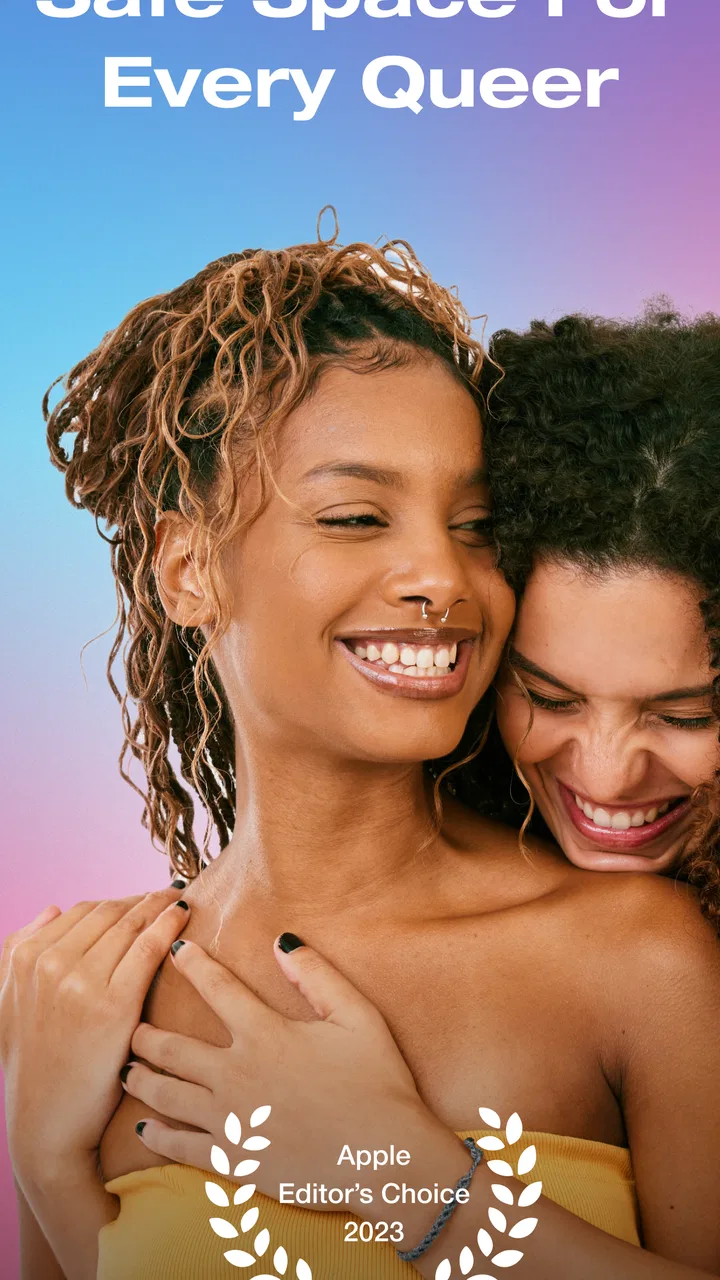
HER Lesbian, bi & queer dating
- 4.3
- Rating
- 5.00M
- Installs
- Free
- Price

 Analysis by App-foxy
I approached HER Lesbian, bi & queer dating less like a quick swiping experiment and more like a test of how a dating app fits into real communication. That distinction matters. Dating platforms can make meeting people easier, but they can also turn attention into a constant obligation: check the app, answer quickly, keep several conversations alive, and decide whether a short profile really tells you anything useful. HER is most interesting when it helps narrow that noise into conversations with people who already understand the communities it serves.
This is a free social app from HER App for gay, bisexual, non-binary, trans and queer women. It has a Mature 17+ rating, so it is aimed at adults and should be used with the same care I would bring to any dating service. The app has been available since June 16, 2016, and its current version is 3.29.23, with support beginning at iOS or Android 9 depending on the device environment.
Why HER feels different from a general dating app
The main reason I would choose HER over a broad dating service is not simply the dating label. It is the possibility of starting from a more relevant social context. On a general app, I often have to spend time working out whether someone understands my identity, what kind of connection they want, and whether the space feels comfortable for them. Here, the audience is more focused from the beginning.
You May Also Like

 Blood Strike: 2.5 Anniversary
Blood Strike’s Loadouts Turn Every Drop Into a Tactical Gamble
A close look at Blood Strike’s custom loadouts: how fast access to signature weapons reshapes its battle royale rhythm, rewards preparation, and narrows the gap between fights.

 Pandora - Music & Podcasts
Pandora’s Music Is Easy to Start, but Harder to Recover
Pandora’s strength is its low-effort path from a seed to a station. Its weak spot is how much confidence it asks you to place in connection, setup, and quiet recovery.

 8 Ball Pool
 Is Built on Rivalries, Rematches, and Routine
A close look at the rivalries, rematches, shared routines, and unanswered safety questions that turn a quick pool match into a persistent mobile community.

 Samsung Music
’s Quiet Strength Is Playing What You Already Own
Its reach comes less from spectacle than from dependable access to a personal library. That simplicity is both the app’s strongest retention engine and its ceiling.

 AccuWeather: Weather Radar
AccuWeather Review: A Quick, Clear Forecast for Everyday Decisions
For everyday plans, the best forecast is the one you can understand quickly. AccuWeather makes rain timing, radar, and local conditions easy to act on, with a few trade-offs.

 Hill Climb Racing
Why Hill Climb Racing Still Turns Crashes Into One More Run
A tiny car, a bumpy hill and one more upgrade: Hill Climb Racing keeps resurfacing because its simple chaos makes every near-miss feel personal.
More From Our News Desk
View All News


That focus does not remove the work of dating. Profiles can still be brief, intentions can still be unclear, and compatibility cannot be guaranteed by belonging to the same broad community. What changes is the opening conversation. Instead of explaining the basic reason I am using a queer-focused service, I can move sooner toward interests, expectations, location, availability, and the kind of relationship I actually want.
I found that especially useful for people who feel worn down by having to filter themselves before they can even flirt. HER is not only a place to look for a partner; it also positions itself as a social network. That makes it more suitable for someone who wants community contact or a softer route into meeting people, rather than treating every interaction as an immediate romantic audition.
That wider social purpose is also a trade-off. If I wanted an app built only around fast romantic matching, a more conventional dating service might feel more direct. HER can be better when I value shared context and a less transactional atmosphere, but I still need to communicate clearly so that social interest does not get mistaken for romantic interest.
Who gets the most value from it
I would recommend trying HER if you are a queer woman, bisexual woman, trans woman, non-binary person, or another person within the audience the app serves and you want a dating space that begins with that understanding. It can be particularly helpful if mainstream apps have made you tired of repeatedly explaining your identity or filtering out people who are not looking for the same kind of connection.
It is also a reasonable option for someone returning to dating after a long break. The focused audience can make the first step feel less intimidating, while the social side gives you a reason to browse without treating every profile as a high-pressure decision. I would not describe it as a shortcut to a relationship, but it can reduce some of the unnecessary uncertainty at the start.
I would be more cautious if you dislike messaging, want a very large pool with no particular community focus, or prefer to keep your dating life completely separate from social discovery. People who want highly detailed compatibility questionnaires may also find that conversation remains more important than any profile-based filtering. In that case, another service with a more structured matching system may suit you better.
How I would set up a calmer first session
My advice is to decide what you are trying to do before opening the app. “Meet someone” is too broad for a useful session. A better goal might be to look at a few profiles, respond to one promising conversation, or see whether the social side feels comfortable. That small boundary prevents browsing from expanding into an evening of distracted swiping.
I would also write a profile that answers the questions I would want answered before starting a conversation. A short statement about what kind of connection I am open to, how quickly I like to communicate, and what I enjoy doing gives other people something concrete to respond to. It also discourages conversations based only on appearance.
One practical tip is to treat the first message as a test of communication quality rather than a performance. Referencing something specific from a profile is more useful than sending a vague greeting, because the reply shows whether the other person can engage with an actual detail. If the exchange stays one-sided, I do not keep investing simply because a match exists.
Conversation flow and the rhythm of replies
HER works best when I use it as a place for deliberate conversation rather than a stream that demands instant reactions. A match or message creates an opening, not a contract. I can answer when I have the attention to hold a real exchange, and the other person can do the same. That sounds simple, but it changes the emotional pressure of dating apps.
In everyday use, I would separate conversations by their stage. A new chat needs light questions and a sense of mutual curiosity. A promising chat needs more specific discussion about interests and expectations. A conversation that has become repetitive needs either a clearer next step or a polite ending. Keeping those stages distinct makes it easier to notice whether the connection is progressing or merely consuming time.
A useful workflow is to move from profile detail to shared topic, then to practical compatibility. For example, I might begin with a hobby, ask what that person enjoys about it, and later discuss whether our schedules or preferred pace would make meeting realistic. This avoids jumping into intense personal disclosure before trust has had time to develop.
I also think the app rewards directness. If I am interested in dating but not in an immediate meeting, I can say so. If I am open to friendship first, that is worth stating. If I am only browsing, I should avoid giving someone the impression that I am ready to build a daily conversation. Clear expectations make the rhythm kinder for both people.
One non-obvious advantage of a community-focused service is that a conversation can begin with less identity-related explanation, but that does not mean every person uses the same language or has the same experience. I still ask rather than assume. Respectful curiosity is more productive than treating a shared category as proof that we will communicate well.
Managing attention without turning dating into a second job
The biggest cost I noticed was not money; it was attention. Dating apps encourage unfinished loops. A profile catches my interest, a message arrives, another conversation pauses, and suddenly I feel responsible for several strangers’ expectations. HER is easier to enjoy when I decide how much of that mental space I am willing to give it.
I would use short, intentional visits rather than checking whenever I feel bored. Before opening the app, I can choose whether I am replying, discovering people, or participating socially. Mixing all three at once makes the experience feel endless. A focused session also helps me notice which interactions genuinely energize me and which ones leave me anxious or distracted.
Another useful boundary is limiting the number of active conversations I can handle honestly. I do not need to reply to everyone immediately, and I do not need to continue every chat that began well. If I am forgetting details or sending rushed answers, that is a sign to slow down. Quality matters more than maintaining a large list of open threads.
This is where HER may suit a different personality from a rapid-fire dating app. Someone who enjoys constant novelty may prefer a busier service with a larger general audience. I prefer the focused approach when I want conversations to have room to develop, but I still have to create that slower rhythm myself. No dating app can impose healthy attention habits on my behalf.
The free price makes trying the app straightforward, although optional in-app purchases range from $0.99 to $179.99 per item. I would not spend anything until I understood my normal usage and knew exactly which limitation I was trying to solve. A paid option should support a clear need, not become a reaction to frustration after a quiet day or an unsuccessful conversation.
Boundaries, safety, and emotional clarity
I treat a dating profile as an introduction, not a verification of character. A thoughtful profile can still belong to someone who is not a good match, and a sparse profile is not automatically a warning sign. I look for consistency between what a person says, how they respond to reasonable questions, and whether they respect a small boundary without trying to negotiate it away.
For a first meeting, I would keep the plan public, tell someone I trust where I am going, and arrange my own way home. I would not share private information simply because a conversation feels intense. Moving from in-app messaging to another channel can be convenient, but I prefer to do it only after the person has shown steady, respectful behavior.
The most useful boundary in my experience is a simple sentence that explains pace: I like talking, but I do not message continuously during the day; or I am interested, but I want to meet only after a little more conversation. This gives the other person a fair chance to respond and gives me valuable information. Someone who respects that is easier to trust than someone who treats access to my time as proof of interest.
There is also a difference between being open-minded and being vague. If I am unsure whether I want friendship, dating, or something casual, I can say that I am still working it out, but I should not imply certainty I do not feel. HER’s social positioning makes this especially important because not every interaction has the same purpose. Clarity prevents friendly community contact from becoming an accidental promise.
I would leave a conversation when it becomes disrespectful, manipulative, or persistently one-sided. I do not need to produce a detailed defense of that decision. A dating app should make room for curiosity, not pressure. The app can provide the setting, but the responsibility for choosing what access I give remains mine.
How it compares with the usual alternatives
Compared with a mainstream dating app, HER’s strongest difference is audience relevance. A general service may offer broader reach, but that reach can bring more filtering work and more conversations where identity or intention needs to be clarified from scratch. HER can make the opening stage more comfortable for people who want a queer-centered environment.
Compared with a friendship-only social network, it keeps romantic possibility close to the surface. That is useful if I want community and dating in the same place, but it means I should be explicit about why I am talking to someone. A friendship platform may be better when I want no romantic ambiguity at all.
Compared with a niche service built around highly detailed matching, HER feels more dependent on the quality of direct communication. I see that as both a strength and a weakness. It leaves space for chemistry that a questionnaire might miss, yet it also means I must ask better questions and judge compatibility myself instead of expecting the app to calculate it.
For someone who wants the widest possible pool, another large dating service may be more practical. For someone who wants a community-aware starting point and is willing to communicate with intention, HER has a clearer reason to exist. The right choice depends less on which app has the most activity and more on which kind of filtering I want to do: filtering by broad reach, or filtering by shared context.
What the numbers suggest about its place
The app holds a 4.3 average from around 72 thousand ratings, and it has passed five million installs. Those figures suggest that HER has reached a substantial audience rather than remaining a tiny specialist service. It also has around 14 thousand written reviews, which gives prospective users a useful reminder that experiences will vary widely by location, identity, age, and dating goals.
I would not read popularity as a promise that my local experience will be equally active. Dating apps are shaped by who is nearby and who is currently using them, so the practical test is whether the profiles and conversations available to me feel relevant. The audience size makes trying HER reasonable, but it does not remove the need to evaluate the quality of my own matches.
My final verdict on everyday use
After using HER as a communication tool rather than an endless catalogue, I came away with a positive but measured impression. Its best quality is the way a focused audience can reduce the amount of explaining required at the beginning. That creates more room for the things that actually determine compatibility: curiosity, timing, honesty, boundaries, and whether both people make an effort.
HER is most valuable when it helps you communicate with more intention, not when it keeps you online for longer. I would recommend it to queer users who want dating and social discovery in a community-aware setting, especially those who are tired of mainstream apps feeling impersonal or poorly matched to their experience.
I would skip it if I wanted a purely friendship-based space, a highly automated compatibility system, or a huge general audience with rapid turnover. I would also avoid paying for extras until I had established a healthy routine with the free version. The app can open doors, but it cannot decide which conversations deserve my energy.
My practical recommendation is to try it with a clear purpose, write a profile that sets expectations, keep the number of active chats manageable, and treat respect for your pace as an important compatibility signal. Used that way, HER feels less like a demand for constant attention and more like a place where a good conversation has a chance to develop.
FAQs for HER Lesbian, bi & queer dating
01What is HER Lesbian, bi & queer dating, and who is it designed for?
HER is a dating and social networking app created primarily for lesbian, bisexual, queer, and other LGBTQIA+ women and non-binary people. It combines dating profiles with community features, allowing users to discover potential matches, join conversations, explore events, and connect around shared interests. The exact experience can vary by location, age, and the availability of local users.
02Is HER Lesbian, bi & queer dating free to use?
HER can generally be downloaded and used without paying, with core features such as creating a profile, browsing members, and participating in parts of the community available on the free plan. However, some functions may be restricted behind optional premium subscriptions or in-app purchases. Before subscribing, check the current pricing, renewal terms, and included benefits shown in the app store or inside the application.
03How does matching and messaging work on HER?
After setting up a profile, you can browse other members and indicate interest according to the options available in the app. When interest is mutual, messaging may become available, while community spaces can offer additional ways to interact without relying only on traditional matching. Features and limits may change over time, so users should review the current interface and privacy settings before sharing personal information.
04Is HER safe and private to use?
HER includes tools intended to support a safer LGBTQIA+ dating environment, such as profile controls, reporting, blocking, and moderation features. Nevertheless, no dating platform can eliminate every risk. Avoid sharing your home address, financial details, passwords, or intimate content with strangers, and consider using in-app communication until trust is established. Meet in public places and tell someone you trust about first dates.
05Can I use HER if I am outside a major city or looking for community rather than dating?
You can use HER from many locations, but the number of nearby profiles and the quality of local discovery will depend heavily on your area. Users in smaller towns may see fewer potential matches or need to expand distance preferences. The app is not limited to dating: community discussions, interest-based conversations, and events may make it useful for meeting LGBTQIA+ people even when you are not actively seeking a relationship.
Pros
- Inclusive space designed specifically for lesbian
- bi
- and queer women.
- Offers social content and communities beyond traditional dating profiles.
- Useful filters help narrow matches by interests and relationship goals.
- Profile verification features can help improve trust and authenticity.
- Available on both Android and iOS for convenient cross-platform access.
Cons
- Some features and interactions may require a paid subscription.
- The active user pool can vary considerably by location.
- Free users may encounter limits on messaging or profile visibility.
- As with any dating app
- fake or inactive profiles can still appear.
- Location-based matching may raise privacy concerns for some users.

HER Lesbian, bi & queer dating
Gallery